Moleskine notebooks & why it's okay to be performative.

I was thirteen when I received my first moleskine. I’d had a sleepover the night before: ten friends, a sea of blow-up mattresses, and a cake topped with fondant books. I don’t remember what we did, or even whether I enjoyed it, but I know that some of us woke up with biro moustaches.
I’d opened presents shortly before midnight, but one friend had waited. Her mum wanted to be there, she said.
“She wants to see your reaction.”
Her mum - crucially - was an English teacher.
The next morning, I teased back the wrapping paper. Inside, was a notebook. Thin, red, with a plain cover and a thin plastic membrane holding everything in place.
“This is what all the great writers used,” her mum told me. “All great writers love moleskines.”
I felt the weight of that.
This slim red notebook wasn’t just a notebook. It was a symbol, and I knew she was telling the truth because she was an English teacher (at thirteen, I trusted English teachers more than any other species of person… to be fair, I think that’s probably still the case!).
The plastic membrane remained, however, for quite some time. You see, I was vegetarian, and when I heard ‘mole skin’, I panicked. I didn’t want to use a notebook made from moles, not even one recommended by an English teacher.
It was only a year later, when I learnt that it was not made from real moles, that I opened it. The paper was uncharacteristically smooth and undeniably luxurious - nothing like the decorative Paperchase notebooks which, up until that point, had been my instruments of choice… I was instantly hooked and have filled dozens of moleskines since. Like so many others, it became my ‘notebook of choice’ .
Even in 1998, a mere year after moleskine launched, booksellers reported dedicated customers coming in every week to buy a new one, and refusing to try anything else. Back then, a red moleskine would have been laughable.
No, no, that’s not a moleskine, someone would invariably say if I went back in a time machine. Moleskines are BLACK.
It was only after Leichturmm popped up as a competitor - complete with a colour wheel of choices - that moleskine reluctantly made navy, red and green available too.
The moleskine is beloved because it is elegant - and I mean that in the mathematical sense of the word.
[s]implicity is the ability to strip everything unnecessary, revealing the core of a problem or solution. True elegance is when complexity is distilled into a clear and concise form, fostering deeper understanding without sacrificing accuracy. (Hideous Humpback Freak)
I think the moleskine has a similar quality… it is skillfully simple. The moleskine has some essentials (a map, timezones, a spot for contact information), but it is sparsely furnished. And I think that’s actually quite an impressive thing.
I’ve run a stationery shop for nearly nine years, and am always looking to add new and exciting spreads to our planners. I like to add extra illustrations to the interior pages, and commission a favourite artist for the cover. I love what we create at Pumpkin Productivity (ad - brand founder), but it is not elegant in the way that the moleskine is.
It is also, undeniably, a luxury item. Moleskines are not cheap as far as notebooks go - but nor are they expensive. They have the impression of leather without the cost (meant both in terms of finances and cruelty to the mole population), and they feel substantial when you hold one between both hands.
The ‘luxury’ comes, I think, from its symbolic value. Among journallers and writers, the moleskine has literary legacy… Hemingway, Picasso, Chatwin: all of these creatives used moleskines. Indeed, moleskine, as a company, was inspired by Chatwin’s book The Songlines, where the narrator laments that his favourite Parisian notebook has been discontinued:
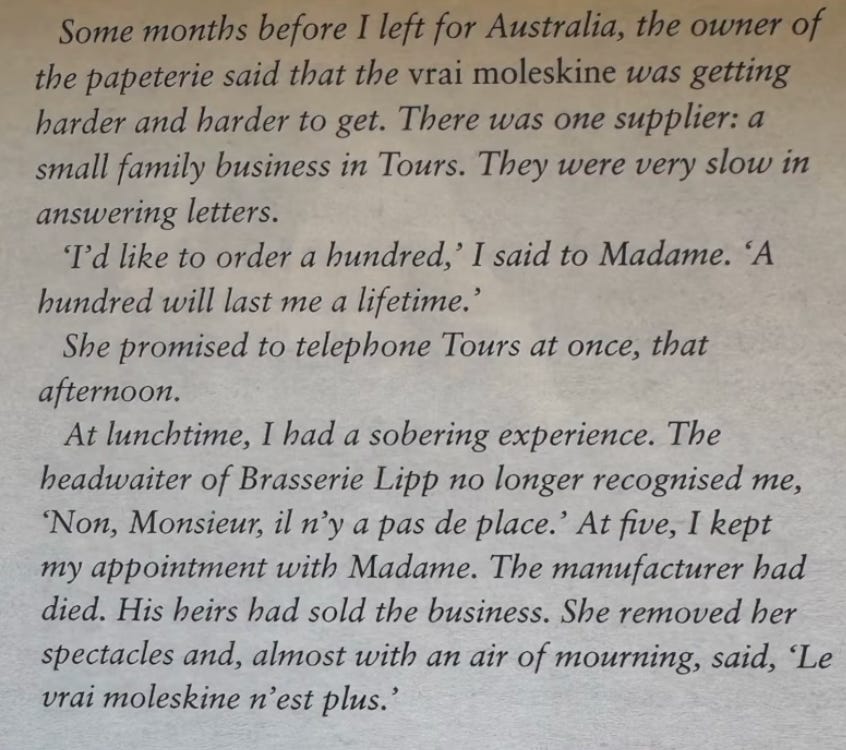
Realising that Chatwin’s semi-fictional character was right, and these Parisian oil-skin notebooks were no longer being made, Maria Sebregondi co-founded moleskine shortly afterwards and brought the notebooks back.
When you use a moleskine, you too are tapping into this history - just as that wise English teacher told me the day after my thirteenth birthday.
The question I have been toying with, therefore, is whether this is performative. Moleskines have social capital, and certainly work as signifiers among those who use them… and doesn’t this mean they are inherently performative?
Yes and no — but not in a bad way.
Saussure says that language is built on ‘signifiers’ and the ‘signified’. The word is the signifier and the object or thing is the ‘signified’. For example, in English we share an understanding that the “signifier” ‘apple’ refers to this:
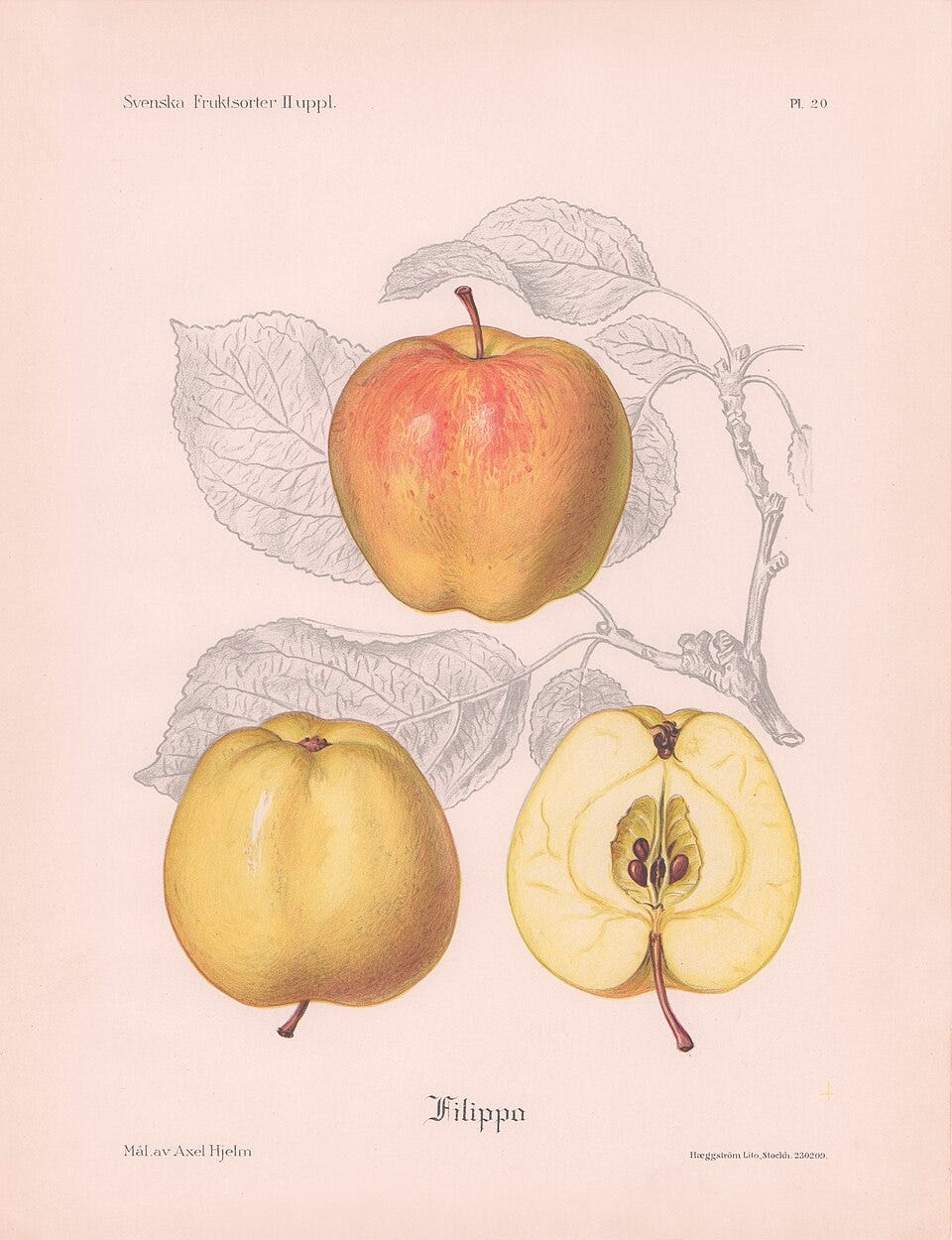
But the ‘signified’ also contains allusions and ideas and associations - which are different for all of us. The apple is a symbol of truth (Tree of Good and Evil), but also of health (’an apple a day keeps the doctor away’), and also sometimes of ‘coolness’ (i.e. the recent idea that ‘eating an apple has the cool factor as smoking a cigarette’).
Any of the above might influence your decision to eat an apple (consciously or unconsciously). You might grab an apple as a healthy snack - and does that mean you are performing ‘health’, or does that mean you are being healthy?
What about if you eat an apple whole because you feel ‘cool’ when you eat it (whatever that means). Let’s say you were by yourself, and that that ‘coolness’ was a nice feeling. Is that performative…?
Well, yes. I think it is performative. But I also don’t think that is a bad thing. You have simply created a story around the object - which we all do every day because we are human and humans tell and create stories.
I like to call these ‘story-filled objects’ — and when you interact with Story-Filled Objects, you perform something which creates meaning for yourself.
The moleskine notebook is also a ‘story-filled object’, and can similarly be performative.
And, when I say that, I mean that the moleskin becomes a prop which helps you understand and tap into the person you want to be and the narrative you are trying to embody.
There are so many things help us to do this - things that get us into a particular headspace (think of how you feel when you wear your favourite blazer, or drink from that teacup, or spend that extra time putting your sandwich together so it actually looks nice… which happens rarely for me, I will say).
I think, by and all, we do this less for others and more for ourselves. We do this for ourselves to make everyday things more special.
It is a beautiful thing when we perform rituals for ourselves. It is a way for us to respect the value of our time and the brevity of each moment.
When I write in a nice notebook or a nice pen, I find myself feeling the weight of what I am doing.
As that English teacher said - “all great writers wrote in moleskines”. The moleskine, as a connective vessel, reminds us, constantly, that we are human too and that we are capable of such things.
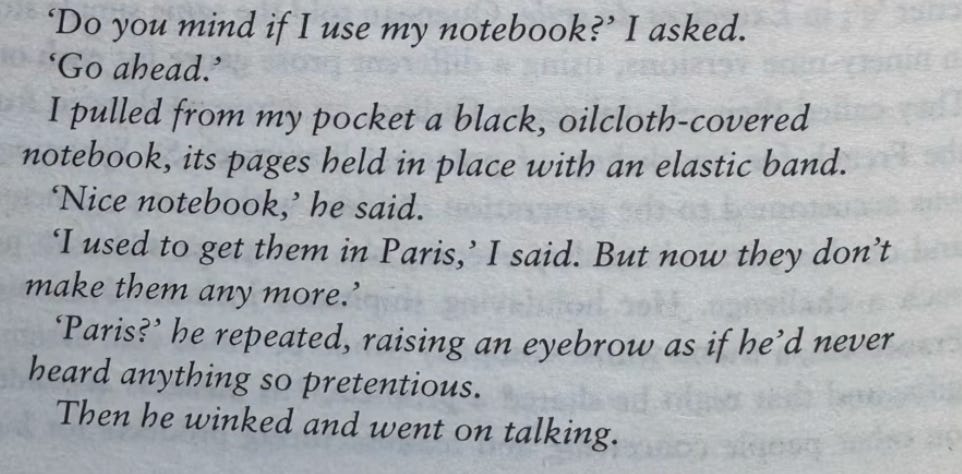
The best notebook is one you use. Be it a moleskin, field notes or a $1 notebook from the newsagent. It’s only performative if you don’t actually use it.
Hi Ruby…perfect timing on this post. I just purchased my first Moleskin. It is black. I hope I enjoy it as others do. 🤞🏻